
Infrastructure Drift: The Silent Risk Most Organizations Miss


Your IT infrastructure probably does not look exactly the way it did a year ago.C
A firewall rule was added to solve a connectivity problem. A new network was created. A vendor received temporary access. A switch was replaced. A DNS setting changed. An administrator account was created.
Individually, these changes may have been completely reasonable.
The problem is what happens afterward.
Was the temporary rule removed? Does the vendor still need access? Was the documentation updated? Are configurations still consistent across locations?
When small changes accumulate without being reviewed against the intended design of the environment, infrastructure drift develops.
Nothing necessarily stops working.
That is what makes it easy to miss.
When the Environment Slowly Changes
Infrastructure drift is the growing difference between how an IT environment was intended to operate and how it actually operates today.
It can appear through everyday changes:
- Temporary firewall rules that become permanent
- Old administrator accounts that remain active
- Networks created without consistent policies
- Security exceptions that outlive their purpose
- Different configurations across locations
- Legacy equipment that remains because it still works
- Changes that were never properly documented
None of these necessarily creates an immediate outage.
Instead, they gradually make the environment harder to understand, manage, troubleshoot, and secure.

Working Does Not Mean Controlled
Organizations naturally notice infrastructure problems when something stops working.
Internet connectivity fails. Wi-Fi becomes unstable. A server becomes unavailable. Users cannot reach an application.
Infrastructure drift behaves differently.
Imagine a firewall rule created to give a vendor access during a project. The project ends, the vendor moves on, and the rule remains.
Nothing breaks. Nobody calls IT. There may be no alert at all.
A year later, the access still exists — but the business reason for it does not.
The same can happen with administrator accounts, network configurations, security exceptions, remote access, and legacy systems.
From the user's perspective, everything works.
But working infrastructure is not necessarily controlled infrastructure.
Small Differences Create Bigger Problems
Consider an organization with several locations that originally followed the same infrastructure standards.
Over time, one site receives a special firewall exception. Another has an older switch. A third uses different DNS settings. Another missed a configuration update.
Eventually, IT can no longer assume each environment follows the same design.
Instead of asking:
“What should this system be doing?”
The question becomes:
“What is this particular system actually configured to do?”
Every unnecessary difference adds complexity.
And complexity makes both reliability and security harder to maintain.

Drift Creates Security Blind Spots
Infrastructure drift is also a cybersecurity issue.
Security controls depend heavily on configuration.
A firewall only enforces the rules configured on it. Network segmentation only protects systems if the appropriate boundaries remain in place. Administrative access is only restricted if unnecessary accounts and permissions are removed.
An organization can therefore invest in modern security technologies while risk quietly accumulates underneath them.
The security tools may be working exactly as designed.
The environment around them has changed.
That is why infrastructure visibility matters. Organizations need to know what exists, how it is configured, what changed, and whether those changes are still appropriate.
Documentation Is Not Enough
Documentation establishes what the environment is supposed to look like.
The infrastructure itself determines what is actually happening.
A network diagram may show two networks as isolated. The firewall configuration determines whether they really are.
Documentation may list three administrators. The identity platform may contain five.
Documentation provides the reference point. Validation determines whether reality still matches it.
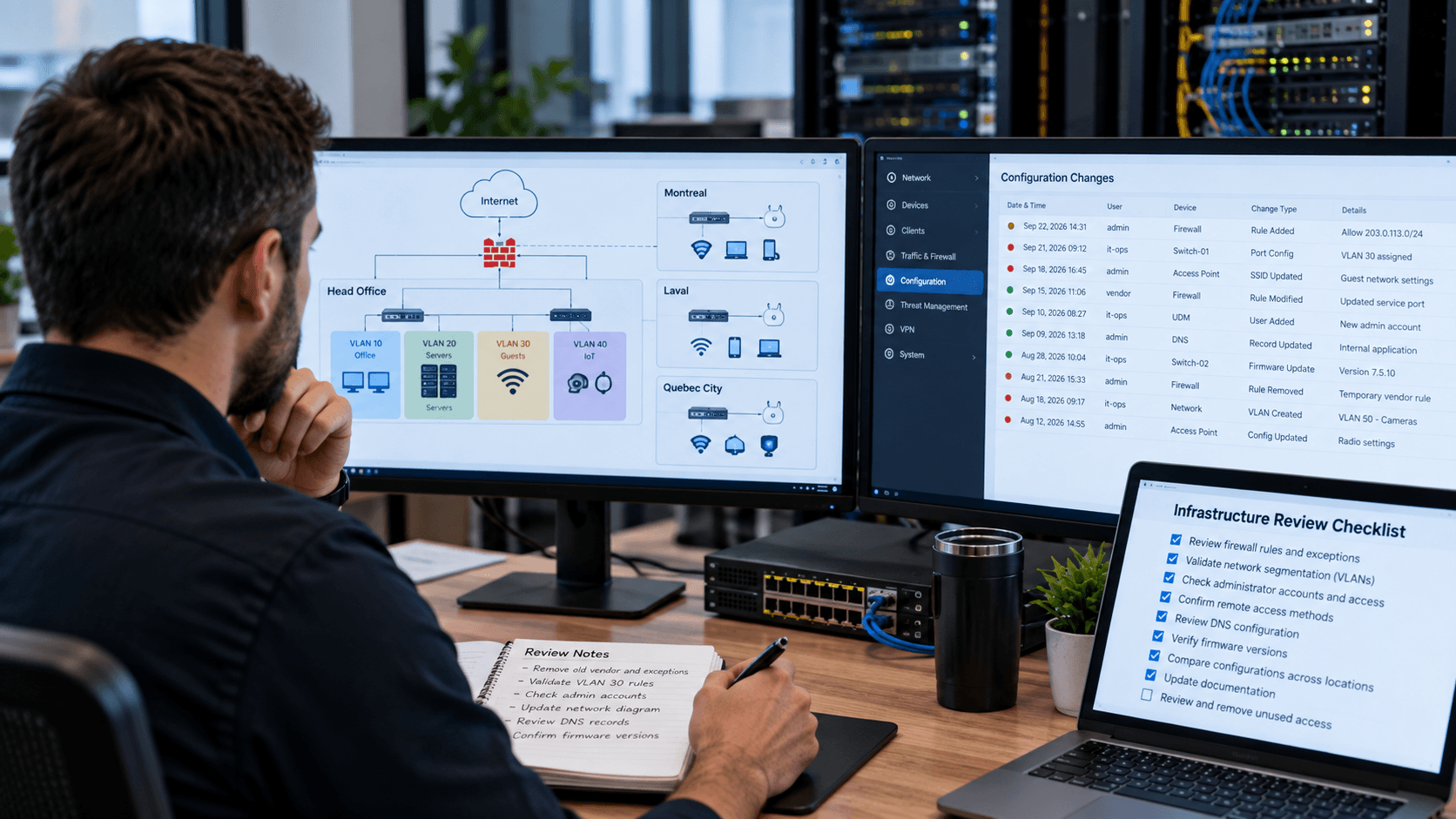
Establish a Baseline — Then Make Change Visible
You cannot identify drift without knowing what the approved environment should look like.
That requires a baseline.
Organizations should have defined expectations for areas such as network architecture, segmentation, firewall policies, administrative access, remote access, DNS, monitoring, and device configuration.
The baseline does not prevent change.
It gives you something to compare change against.
When an exception is required, the important questions become clear:
What changed? Why did it change? Who approved it? Does it still need to be there?
Infrastructure will continue evolving as applications, employees, vendors, locations, and business requirements change.
The objective is not to stop that change.
It is to make change visible, intentional, documented, and reviewable.
The Infrastructure You Think You Have
Infrastructure drift rarely announces itself with an outage or a major warning.
It develops quietly while everything continues working.
That makes one question particularly important:
Does the infrastructure operating today still match the infrastructure you believe you are managing?
If that cannot be demonstrated, the problem is not simply outdated documentation.
It is a visibility gap.
Infrastructure will change.
The risk begins when those changes become invisible.